
| Tech Inspections And Sound Tests |
No Race Numbers
Dual sporting is a recreational riding event, not a race. The general public thinks
that a dual sport motorcycle is a "dirtbike", imagine what they think when a
bunch come off the trails loaded with numbers and race stickers on them. Not a
good impression for the sport! Remove them prior to tech inspection.
Working Lights, Mirror.
Dual sport is STREET LEGAL. That means the vehicles have to be street legal.
Hence, the difference between dual sport and off-road vehicles. Imagine during
an event a person gets pulled over and they do not have the proper equipment
on their bikes. What does this mean to the promoter who must apply for special
event permits on public lands and explain to the USFS or State Agencies why
the people participating on open roadways have illegal bikes. How long do you
think they will still issue those special use permits?
License Plate (Tag) Firmly attached (bolted) to the motorcycle.
Once again, we're talking street legal. It is not legal to have a tag strapped to
your chest protector. Once again see the paragraph above. Promoters have to
jump through a lot of hoops to obtain special use permits, and riders like to
ride. It's not too much to ask that you bolt your tag onto your bike.
Sound Test
Sound is our biggest enemy. Even a quiet bike is a disturbance to non-riders in
the forest, and they are vocal with the overseeing governmental agencies.
Once again, promoters are put on the spot, and other riders must face the
consequences of your actions.
Dual sporting is a recreational riding event, not a race. The general public thinks
that a dual sport motorcycle is a "dirtbike", imagine what they think when a
bunch come off the trails loaded with numbers and race stickers on them. Not a
good impression for the sport! Remove them prior to tech inspection.
Working Lights, Mirror.
Dual sport is STREET LEGAL. That means the vehicles have to be street legal.
Hence, the difference between dual sport and off-road vehicles. Imagine during
an event a person gets pulled over and they do not have the proper equipment
on their bikes. What does this mean to the promoter who must apply for special
event permits on public lands and explain to the USFS or State Agencies why
the people participating on open roadways have illegal bikes. How long do you
think they will still issue those special use permits?
License Plate (Tag) Firmly attached (bolted) to the motorcycle.
Once again, we're talking street legal. It is not legal to have a tag strapped to
your chest protector. Once again see the paragraph above. Promoters have to
jump through a lot of hoops to obtain special use permits, and riders like to
ride. It's not too much to ask that you bolt your tag onto your bike.
Sound Test
Sound is our biggest enemy. Even a quiet bike is a disturbance to non-riders in
the forest, and they are vocal with the overseeing governmental agencies.
Once again, promoters are put on the spot, and other riders must face the
consequences of your actions.
Joel Reasons BMW HP2
Bike Week Sound Test
Bike Week Sound Test

Sound Crew Devil's Creek
This KLX250 get's the once over..
This KLX250 get's the once over..
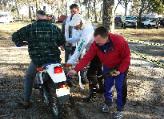
We only allow one bike in the testing area to be running at a time so they
don’t add to each other’s sound level.
Our equipment is professional grade, and calibrated prior to each event. On
occasion we do use hand held devices for spot checking machines. We've
tested over a thousand bikes using the same method, creating a baseline from
which we work.
Microphone placement is very important. Imagine a line drawn in space that
starts at the tip of the exhaust and extends out at a 45° angle from the long
axis of the bike and is level with the ground. We place the tip of the
microphone of the sound level meter (SLM) 20” away from the exhaust tip, and
hold it perpendicular to that imaginary line. So the SLM is facing basically
backwards relative to the bike.
We test the sound level when the bike is at 3400 rpm, which is about half the
redline rpms for most 4-stroke singles. This is per AMA sound check guidelines,
which recommends 3400 rpm as a good engine speed for most bikes. We
have a device that can tell us when the engine is at that speed and all we
have to do is put it in contact with the bike. We have been using the rear
fender/taillight assembly as a contact point but I’ve been doing some research
on the subject and found that the AMA recommends using the handlebars as a
contact point. It makes sense because the engine vibration, as we all know, is
easily transmitted through the handlebars. We have verified the indicated rpm
on the device with the rpms on bikes that have tachs and they are pretty darn
close to each other. If you have a tach, we go by that number.
The DixieDualSport limit is 92 dBA. If you have an unmodified stock muffler in
good condition and it is above that number by a reasonable margin (keep in
mind that the sound level doubles every 6 decibels, so a little bigger number is
a lot louder), we pass the bike. If the muffler is in sad shaper, or you have an
aftermarket exhaust and are above the limit, then you have to go make some
changes (remove discs or repack) and be retested in order to pass. C
Converted off-road bikes are louder than D.O.T. bikes, since they do not have
to meet the same requirements by the EPA. An unmolested DRZ400 will usually
come in between 88 and 90 dBa. A stock KTM 450/525 EXC comes through
about 94-96.
Sound is a learning curve. many riders do not know how loud their bikes are.
We understand this.
92 and below gets you a pat on the back.
92-94 You pass, but iit get's you a lesson on paying attention to your pipe.
94-96 You pass and get's you a lesson on repacking, a lecture on the
importance of a quiet bike and the impact that sound makes on non-motorized
forest users and forest residents. No one likes a loud motorcycle.
Above 96 dBa: Sends you back to your truck to rdo your exhaust. Get's your
name on our "watch" list for any future events, in addition to a trip back to
your truck to try to quiet it down. Repacking, removing disks, whatever. Do not
come back to us with steel wool stuffed in your pipe or an inner tube over the
end. You're doing yourself and the motorcycling community a diservice.
Keep it stock. Keep it quiet.
Rich Bumar
Environmental Engineer
Dixie Sound Master
don’t add to each other’s sound level.
Our equipment is professional grade, and calibrated prior to each event. On
occasion we do use hand held devices for spot checking machines. We've
tested over a thousand bikes using the same method, creating a baseline from
which we work.
Microphone placement is very important. Imagine a line drawn in space that
starts at the tip of the exhaust and extends out at a 45° angle from the long
axis of the bike and is level with the ground. We place the tip of the
microphone of the sound level meter (SLM) 20” away from the exhaust tip, and
hold it perpendicular to that imaginary line. So the SLM is facing basically
backwards relative to the bike.
We test the sound level when the bike is at 3400 rpm, which is about half the
redline rpms for most 4-stroke singles. This is per AMA sound check guidelines,
which recommends 3400 rpm as a good engine speed for most bikes. We
have a device that can tell us when the engine is at that speed and all we
have to do is put it in contact with the bike. We have been using the rear
fender/taillight assembly as a contact point but I’ve been doing some research
on the subject and found that the AMA recommends using the handlebars as a
contact point. It makes sense because the engine vibration, as we all know, is
easily transmitted through the handlebars. We have verified the indicated rpm
on the device with the rpms on bikes that have tachs and they are pretty darn
close to each other. If you have a tach, we go by that number.
The DixieDualSport limit is 92 dBA. If you have an unmodified stock muffler in
good condition and it is above that number by a reasonable margin (keep in
mind that the sound level doubles every 6 decibels, so a little bigger number is
a lot louder), we pass the bike. If the muffler is in sad shaper, or you have an
aftermarket exhaust and are above the limit, then you have to go make some
changes (remove discs or repack) and be retested in order to pass. C
Converted off-road bikes are louder than D.O.T. bikes, since they do not have
to meet the same requirements by the EPA. An unmolested DRZ400 will usually
come in between 88 and 90 dBa. A stock KTM 450/525 EXC comes through
about 94-96.
Sound is a learning curve. many riders do not know how loud their bikes are.
We understand this.
92 and below gets you a pat on the back.
92-94 You pass, but iit get's you a lesson on paying attention to your pipe.
94-96 You pass and get's you a lesson on repacking, a lecture on the
importance of a quiet bike and the impact that sound makes on non-motorized
forest users and forest residents. No one likes a loud motorcycle.
Above 96 dBa: Sends you back to your truck to rdo your exhaust. Get's your
name on our "watch" list for any future events, in addition to a trip back to
your truck to try to quiet it down. Repacking, removing disks, whatever. Do not
come back to us with steel wool stuffed in your pipe or an inner tube over the
end. You're doing yourself and the motorcycling community a diservice.
Keep it stock. Keep it quiet.
Rich Bumar
Environmental Engineer
Dixie Sound Master
Kirk Braden's DR350

Devil's Creek
Copyright 1997-2010 DixieDualSport, Inc All Rights Reserved Contact The WebMaster |

| A Riders Club For: Florida - Georgia - Tennessee - Alabama - South Carolina - North Carolina - And Beyond! |
| More Than A Club, We're Family! |